
Community Stories
The Cultural Evolution of the San Fernando Valley: How Canoga Park Became the West Valley's Arts District
9/1/2026
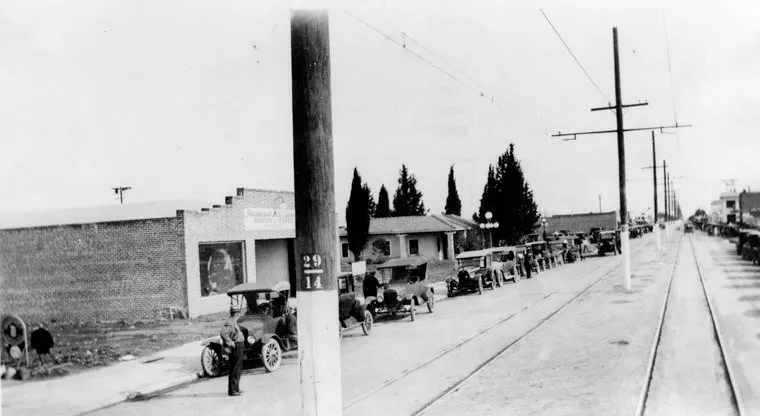
Photo: "1920 Sherman Way in Downtown Owensmouth" / LA Public Library via Wikimedia Commons, public domain
One building on Sherman Way has been a silent movie palace, a discount cinema, a controversial adults-only theater, an earthquake casualty, and a city-owned performing arts venue — and the block around it tells almost the entire cultural history of the West Valley.
Every neighborhood in our coverage area has a piece of the Valley's cultural story, but Canoga Park's piece is the one you can stand on a single street corner and see all at once. One building on Sherman Way has been a silent movie palace, a discount cinema, a controversial adults-only theater, an earthquake casualty, and a city-owned performing arts venue, in that order. The block around it went from farm-town storefronts to a nationally known antique district to today's self-branded Arts District. This installment of our Evolution series follows that one street corner, because it carries almost the entire cultural history of the West Valley on its own.
A Silent Movie House, 1926
The Madrid Theatre opened on November 24, 1926, when the town was still called Owensmouth. It was built by N. Schelenberg and M.P. Horwitz as a 600-seat silent movie house, complete with an elaborate organ shipped in from the Robert Morton Organ Factory in Van Nuys. By the time the town renamed itself Canoga Park, the theater had renamed itself too, becoming the Canoga Theatre in the 1939/40 city directory. For decades it did what small-town movie houses did: it showed whatever Hollywood was releasing, to whoever showed up.
A Different Direction, the 1960s to 1994
By the mid-1960s the theater had changed again, renamed the Park Theatre and focused on adult films. It later joined the Pussycat Theatres chain as the Park Pussycat. It wasn't uncontroversial locally: an LA Times article from January 1966 documents a contentious neighborhood hearing over the theater's police permit, with residents arguing its programming crossed a line. The theater kept operating under that model for roughly three decades, until it closed in 1994 after the Northridge earthquake damaged the building beyond use.
Antique Row Grows Up Around It
While the theater cycled through those changes, the storefronts around it were changing too. In the 1960s, the same decade Topanga Plaza and Fallbrook Mall opened and pulled a lot of conventional retail toward enclosed malls, many of the older shops along Sherman Way repositioned as antique and specialty stores. The strip earned a name that stuck: Antique Row. It's a pattern worth noticing: as big-box retail moved to the malls, this stretch of downtown Canoga Park found a different, more specialized identity instead of competing head-on and losing.
Rebuilding, 1994 to 1998
After the earthquake closed the old Pussycat building, the City of Los Angeles acquired the property and demolished the structure entirely. What replaced it was a genuinely new building, not a restoration, designed by FSY Architects and built as a dedicated live performance venue. It reopened December 12, 1998, under the name Madrid Theatre once again, this time as a nonprofit-facing cultural venue owned and operated by the city's Department of Cultural Affairs rather than a private theater chain. Since then it's hosted dance, music, theater, conferences, and film festivals for the surrounding community.
An Arts District, on Purpose
Antique Row's identity kept evolving too. Today the area brands itself more broadly as an Arts District, with a formal Property-Based Improvement District (PBID) funding revitalization along Sherman Way, a monthly Canoga Park Art Walk on the third Thursday drawing artists into more than a dozen storefronts, and public murals scattered through downtown. The Madrid Theatre itself is mid-renovation as of this writing, a 2023 to 2027 project with architecture firm Gensler bringing a mid-century modern redesign, new audio and lighting systems, and a redesigned second-floor lobby, funded and driven by the same city department that's owned it since 1998.
What's notable is the throughline: Canoga Park didn't get a cultural identity handed to it. Downtown Canoga Park has actively reinvented what "culture" means on that block roughly once a generation, silent film, adult cinema, antiques, and now a deliberately cultivated arts district, without ever losing the same physical footprint it started with in 1926.
A Note on Chatsworth and Winnetka
Chatsworth's own cultural throughline runs through a very different institution, the Iverson Movie Ranch, which deserves its own dedicated treatment given how extensively it was used across film and television history rather than a passing mention here. Winnetka doesn't have neighborhood-specific cultural history sourced for this piece yet, flagged here rather than guessed at, to be filled in once Winnetka coverage is scoped.