
Community Stories
The Economic Evolution of the San Fernando Valley, and the West Valley's Place in It
8/6/2026
Updated 8/21/2026
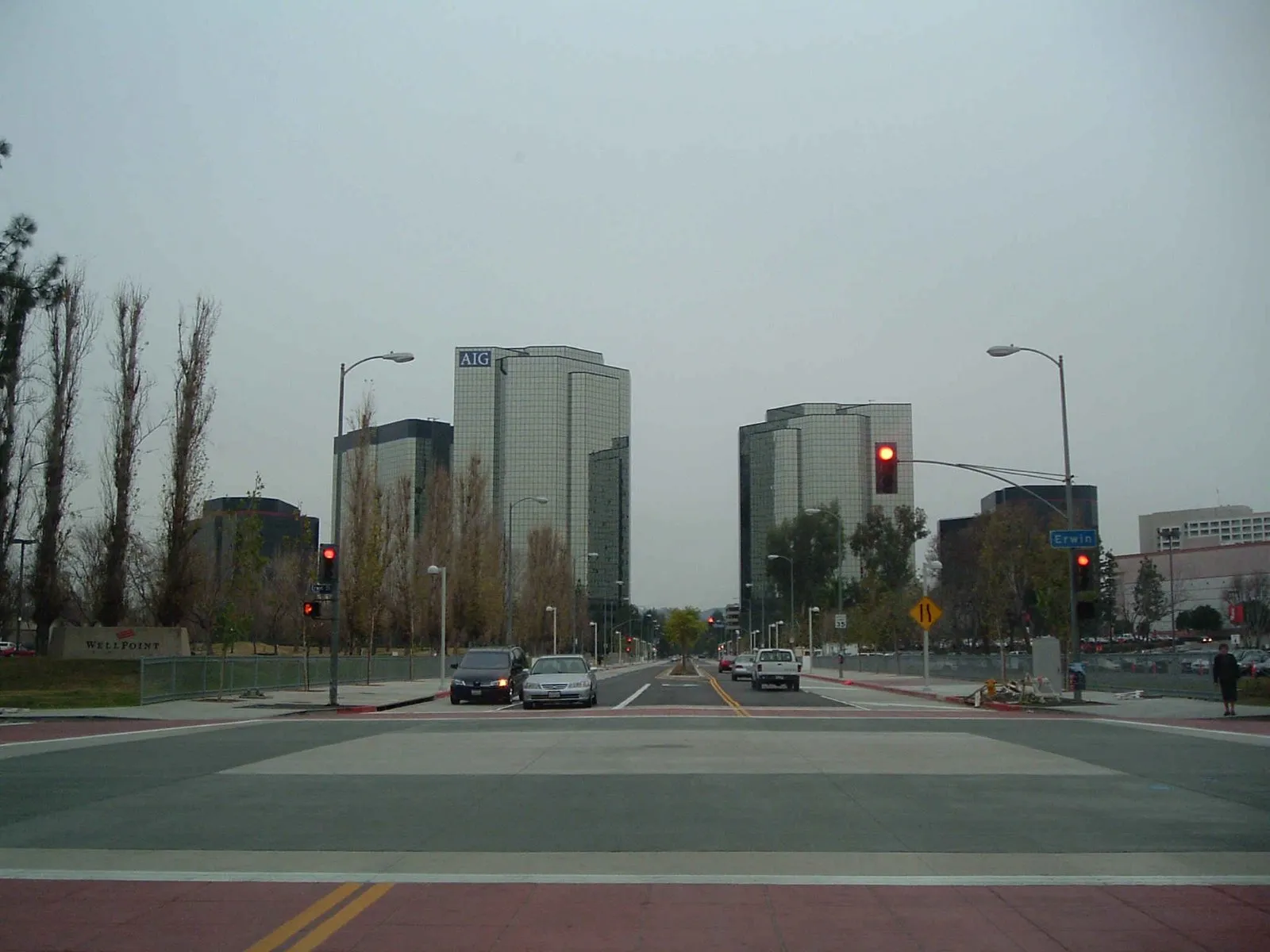
Photo: "Warner Center Skyscrapers" by Lan56, Public domain (Resized and converted to WebP for web display.)
From cattle ranches to a wheat empire, from orange groves to a rocket-engine boom that helped put America on the moon, to the office towers of Warner Center today. The ground under the West Valley has changed jobs more times than most people change careers.
Stand at the base of a Warner Center office tower today and it's hard to picture what was here before the glass and concrete. But the ground underneath has changed jobs more times than most people change careers: from grazing land, to a wheat empire, to citrus groves, to rocket engines that helped put America on the moon, to the office towers and shopping centers that define the West Valley skyline now. Here's how we got from one to the other.
Ranchos and Cattle (Late 1700s–1860s)
Before any of it was farmland, the western San Fernando Valley was cattle country, part of the vast rancho system that followed the Spanish mission era. Grazing dominated the local economy for the better part of a century, a slower, more open-range way of life than anything that followed.
The Wheat Empire (1860s–1910s)
Two back-to-back disasters ended the cattle era for good: the Great Flood of 1861–62, then a punishing drought from 1863–65 that wiped out a huge share of the region's cattle herds. Landowners pivoted hard, subdividing old rancho land for grain. A syndicate led by Isaac Lankershim and his son-in-law Isaac Van Nuys (names that still mark Valley streets today) built one of the largest dry-farming wheat operations in the state, and for a stretch, Los Angeles County was genuinely one of America's wheat-growing centers. Locally, Albert Workman ran part of that same wheat economy on what's now Shadow Ranch Park in West Hills, buying roughly 9,000 acres of it outright in 1869.
Wheat needed rail to reach a market, and that shaped where towns took root. Owensmouth, the original name for what's now Canoga Park and West Hills, was founded on March 30, 1912, specifically to capitalize on land value once aqueduct water reached the area, laid out along the Pacific Electric "Red Car" line that ran down Sherman Way.
Orchards Take Over (1910s–1940s)
As irrigation infrastructure improved through the 1910s, wheat gave way to something more labor-intensive and more profitable per acre: citrus. Southern California's agricultural economy shifted toward orchards rather than grain, and locally, citrus groves became a defining feature of the higher-elevation slopes specifically in Canoga Park and Chatsworth. This was the Valley's "orange grove" era, the postcard image many people still associate with old Los Angeles.
It's also the era that quietly set up the neighborhood's next act: a large stretch of land in what's now Woodland Hills spent these decades as a private horse ranch owned by Harry Warner, the oldest of the Warner brothers of Warner Bros. Studios. Nobody farming citrus nearby in the 1930s could have guessed that ranch would become the commercial core of the entire West Valley within two generations.
The Aerospace Boom (1940s–1980s)
World War II changed everything. The U.S. needed missile technology fast, and North American Aviation recruited German rocket engineers to adapt captured V-2 technology to American specifications. In 1948, the company began testing liquid rocket engines in the Simi Hills (testing grounds that became the Santa Susana Field Laboratory), and in 1954 it bought land nearby for a manufacturing plant. Rocketdyne, founded in 1955, built its headquarters at 6633 Canoga Avenue, surrounded at the time by fields and orchards.
What followed was staggering by any standard: by 1965, Rocketdyne alone employed more than 65,000 people in and around Canoga Park. The plant built engines for the Atlas and Thor missile programs, then the Saturn rockets that powered the Apollo moon missions, then the Space Shuttle's main engines, monitoring every one of the Shuttle's 135 launches from its Canoga Park support center. Litton Industries set up nearby too. For three decades, aerospace wasn't just a local employer. It was the West Valley's economic identity.
Retail and the Corporate Era (1960s–1990s)
While Rocketdyne was still ramping up, a second transformation was starting on the old Warner horse ranch. Topanga Plaza opened there in 1964, Southern California's first enclosed shopping mall, followed through the 1970s and 80s by the Promenade Mall (1973), Kaiser Permanente Hospital (1986), and a wave of corporate office towers that gave Warner Center its now-familiar reflective-glass skyline: Warner Center Plaza I (1983), Warner Center Business Park, and more. What had been a single family's ranch became, within about fifty years, one of the largest business districts in the San Fernando Valley.
Aerospace didn't disappear overnight, but the Cold War's end brought real contraction. Smaller, cheaper satellite technology, more competition, and federal spending shifting toward NASA hubs in other states all pulled work away from the Valley through the 1990s and 2000s.
Where We Are Now
Today's West Valley economy looks nothing like any single era before it. It's a blend of corporate office space (a sector that's faced real headwinds in recent years amid broader remote-work-driven shifts across the LA market), destination retail (Westfield Topanga and The Village), healthcare, and a dense layer of small, independently owned businesses: the restaurants, services, and neighborhood spots that make up most of what West Valley Guide actually covers day to day. It's worth remembering that layer exists on land that's already been a cattle range, a wheat farm, an orchard, and a rocket factory. The neighborhoods absorb change. That part hasn't.
A Note on Chatsworth and Winnetka
Chatsworth shared the Valley's citrus-orchard era directly. It's specifically named alongside Canoga Park as one of the slope-farming citrus areas in our sourcing. As our coverage expands there, this section can be built out further with Chatsworth-specific detail (its film-industry history at Iverson Ranch, in particular, deserves its own treatment). Winnetka doesn't yet have neighborhood-specific economic sourcing pulled for this piece, flagging that gap now rather than guessing, to be filled in once Winnetka coverage is scoped.