
Community Stories
The Political Evolution of the San Fernando Valley, and the West Valley's Place in It
9/22/2026
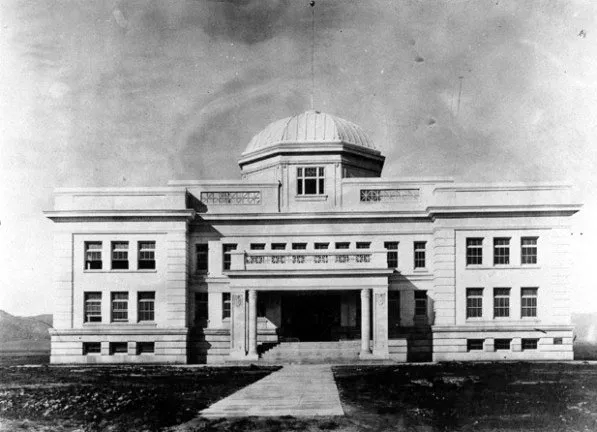
Photo: "Owensmouth Elementary School, 1915" / LA Water and Power Associates via Wikimedia Commons, public domain
Independent town, then annexation, then a rename, then a split, then a near-secession that reshaped how the entire city of Los Angeles governs itself — the West Valley argued its way into the shape it has today.
Every time a West Hills or Canoga Park neighborhood council meets to weigh in on a local project, it's standing on ground that was fought over politically for more than a century. The West Valley didn't just grow, it argued its way into the shape it has today: independent town, then annexation, then a rename, then a split, then a near-secession that reshaped how the entire city of Los Angeles governs itself. Here's that story.
An Independent Town, By Design (1912)
Owensmouth, the original name for what's now Canoga Park and West Hills, wasn't annexed into existence. It was founded as its own town on March 30, 1912, laid out specifically to capitalize on land value once Los Angeles Aqueduct water reached the area. For its first few years, it governed itself.
The Water Deal That Merged the Valley Into L.A. (1915–1920)
That independence didn't last, and water is the reason why. When the Los Angeles Aqueduct opened in 1913, only the City of Los Angeles controlled the new water rights. Valley communities faced a choice: stay independent and go without reliable water, or join Los Angeles and get it. In May 1915, voters across the unincorporated San Fernando Valley approved annexation by a large margin, folding roughly 170 square miles into the city. Owensmouth itself formally annexed in 1917. Chatsworth followed in 1920.
It's worth sitting with what that means locally: the neighborhoods we cover today aren't old Los Angeles. They're former independent towns that traded self-governance for water, a genuinely consequential political decision made by people who couldn't have known it would still shape city council district lines more than a hundred years later.
A New Name, A New Identity (1930–1931)
On March 1, 1931 (some records cite 1930), Owensmouth was renamed Canoga Park, after Canoga, New York, with local civic leader Mary Logan Orcutt helping drive the change. Names carry political weight. Shedding "Owensmouth," a name literally referencing the water fight that ended its independence, was its own kind of statement about the community's identity going forward.
A Community Splits in Two (1987)
By the 1980s, the western portion of Canoga Park wanted its own identity again. Under a petition campaign led by resident Joel Schiffman, that three-square-mile western section separated from the rest of Canoga Park in 1987, officially becoming the neighborhood of West Hills. It's a small, local echo of the exact same instinct that shaped Owensmouth seventy-five years earlier: a community deciding its interests were distinct enough to warrant its own name and its own boundaries.
The Valley Almost Left Altogether (1998–2002)
The West Valley's biggest political moment came in 2002, and it very nearly changed the region's government entirely. Frustration had been building for years, Valley residents felt they paid city taxes and got underinvestment in return, and organizers gathered more than 200,000 petition signatures by December 1998 to force a study on San Fernando Valley secession. The group behind much of that push, Valley VOTE, drew significant support from West Valley communities specifically.
The measure, Proposition F, went to voters citywide on November 5, 2002. The result was remarkably close within the Valley itself: about 50.7% voted yes to secede, versus 49.3% no. But California law required a majority both within the seceding area and across the city as a whole, and the rest of Los Angeles voted against it by a landslide, roughly 80.5% to 19.5%. Secession failed. Had it succeeded, the San Fernando Valley would have become one of the largest cities in the United States overnight, and West Valley Guide would be covering an entirely different municipality than the one we cover today.
The Lasting Result: Neighborhood Councils
Here's the part of this story with the most direct relevance to how WVG operates now. The threat of secession, building since that 1998 petition, pushed Los Angeles to act before the 2002 vote ever happened. Voters approved a comprehensive new city charter in June 1999, the city's first major charter revision in seventy-five years, and its centerpiece was an entirely new system of neighborhood councils designed to give local communities a real voice inside City Hall instead of outside it.
That system is still standing today. The Canoga Park Neighborhood Council, the West Hills Neighborhood Council, and the various Woodland Hills-area councils are all direct descendants of that political fight. The next time a WVG piece cites a neighborhood council position on a local issue, that's the 1998 secession movement, still doing its job.
A Note on Chatsworth and Winnetka
Chatsworth's annexation timeline runs slightly behind the main 1915 Valley vote, joining the city in 1920, which is its own small data point in this same story. Winnetka doesn't have neighborhood-specific political history sourced for this piece yet, flagging that gap now rather than guessing, to be filled in once Winnetka coverage is scoped.