
Community Stories
West Valley Firsts: Southern California's First Enclosed Mall Was Right Here
8/25/2026
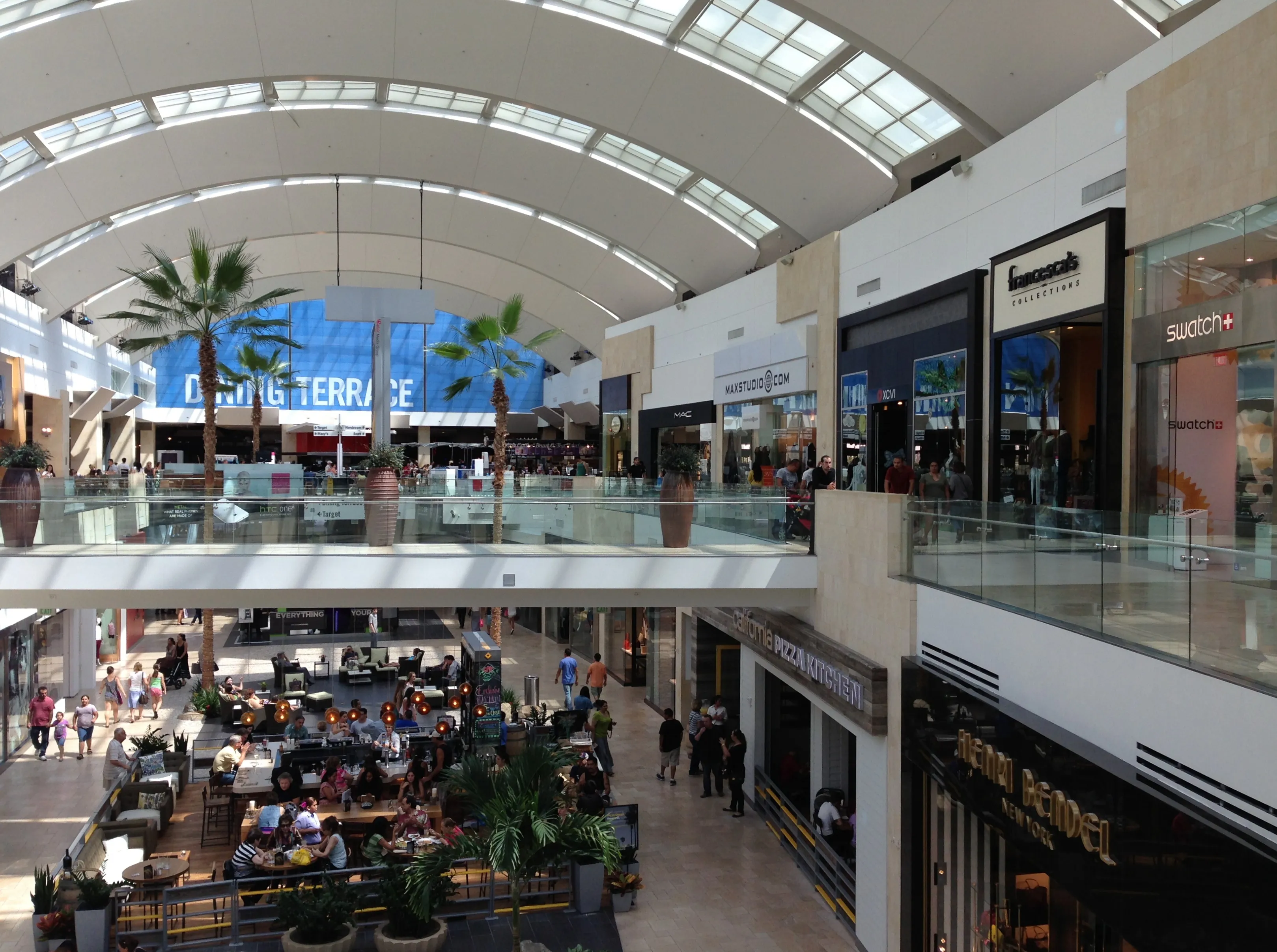
Photo: "Westfield Topanga" by Clotee Allochuku-Albritton, CC BY 2.0 Generic (Resized and converted to WebP for web display.)
It opened on a horse ranch in 1964. It was not the first in the country, and the question of whether it was first in California has at least three answers.
Before Westfield Topanga, before The Village, before any of the shopping centers that define Warner Center today, there was Topanga Plaza. Its first two anchors opened on February 10, 1964, on a 58-acre parcel that had been part of Harry Warner's horse ranch, and it was the first enclosed shopping mall in Southern California.
It nearly had a different name. Through planning it was promoted as West Valley Center, and only became Topanga Plaza by the time ground was broken in February 1963.
That the enclosure mattered is easy to underrate now. In 1964 the norm was open-air. You parked, you walked outside between stores, and in August you did that in Valley heat. Topanga Plaza's fully enclosed, climate-controlled format was a real bet at the time, and it paid off well enough that the format spread across the region over the following two decades.
The architect was Victor Gruen, who had essentially invented the modern enclosed mall eight years earlier and is still routinely called the father of the American shopping mall. The mall opened across two levels with 83 retailers, developed by May Centers of St. Louis. May Company and Montgomery Ward opened first, a Food Fair supermarket followed in April, and The Broadway rounded out the anchors.
Gruen gave it the flourishes to match. A "Rain Fountain," nicknamed the Wonderfall and designed by Vic Chaten of Torrance, stood in the South Court, creating the illusion of falling rain with droplets of recirculated glycerine descending along vertical monofilament lines. The North Court had bird aviaries, planters, and a gazebo. A Terrace Restaurant looked out over it all from above the May Company. An ice arena opened on the lower level in March 1965 and became, for a generation of Valley kids, the thing you actually went there for.
The mall anchored what became the Warner Center commercial district, arriving years before the office towers and nearly a decade before the Promenade opened in 1973.
So Was It Really the First?
Worth being careful here, because "first" claims get repeated far more confidently than they deserve, and we would rather be right than impressive.
It was not the first in the country. That is Southdale Center in Edina, Minnesota, which opened on October 8, 1956, cost $20 million to build, and drew 75,000 people to its gala opening. It is credited as the first fully enclosed, climate-controlled shopping mall in the United States. Gruen designed that one too, around a skylit atrium he called the Garden Court of Perpetual Spring, meant to work as an indoor town square.
Was it the first in California? We spent real time on that question and came back without an answer, which turns out to be the interesting part.
At least three California malls opened in 1964, and the "first in the state" title has been attached to each of them by somebody. Topanga Plaza's first anchors opened February 10. Escondido Village, near San Diego, is commonly described as California's first enclosed and first fully air-conditioned mall, though its own anchor store opened April 6 and its formal dedication came August 6, both after Topanga. Those dates come from a retail-history reference and from a contemporaneous local newspaper account recorded in a reference list. And Wikipedia's entry on Visalia Mall, in the Central Valley, states flatly that Visalia was the first enclosed shopping mall in California when it opened that same year. We have not independently verified Visalia's opening date or its original configuration. We are citing that claim as evidence that the title is contested, not as a fact about Visalia.
Three malls, one year, and no agreement. Nobody is necessarily lying. The category itself was new enough in 1964 that "enclosed mall" had no settled definition. Escondido advertised itself as a shopping center with an "enclosed sidewalk," because the word "mall" still meant a long planted green space rather than a building. When the thing being counted has no agreed definition, first-place claims multiply.
Here is the tell. The most reliable sources in this whole question make regional claims rather than state ones. Gruen Associates says Topanga was the first enclosed mall to open in southern California. Mall Hall of Fame, the retail-history reference, calls it the first major enclosed shopping center in Southern California. That same reference calls Escondido Village greater San Diego's first fully enclosed shopping center, not California's, and a separate account describes it as the region's first fully enclosed complex. The state-level claims come from the thinner sources. That is usually what it looks like when a claim has been inflated in the retelling.
So we are not going to tell you Topanga Plaza was California's first, and we would gently suggest not believing anyone who does without showing their work.
What is documented is narrower and holds up: Topanga Plaza was Southern California's first enclosed shopping mall.
Two sources say so. One is Gruen Associates, the architect, on its own project page, which makes it primary and also promotional. The other is a retail-history reference with no commercial stake in the answer. We cannot establish that the second is independent of the first. A 2008 write-up of a 1964 mall gets its details from somewhere, and the architect's own materials are the obvious place. So: two accounts, not demonstrably two origins. We think the claim is right. We are telling you what it rests on, and every source is linked below.
That is still a real claim. The man who invented the enclosed mall brought the idea to the West Valley before almost anywhere else in this half of the state, and he built it on a horse ranch. That ranch was one turn in a longer sequence, and our Economic Evolution piece follows the same ground from cattle range through wheat, citrus, and rocket engines to the office towers standing on it now.
Sixty-two years later the building is still standing, renovated and rebranded more than once. Whether the bet still holds is a question for a different piece.
Sources
Tier 1
Primary
- Source: Gruen Associates, Topanga Plaza project page. Southern California claim, Harry Warner Ranch land history, 58-acre tract, 83 retailers, May Centers as developer, the three anchors.
Tier 2
Retail history
- Source: Mall Hall of Fame, Topanga Plaza. February 10, 1964 anchor openings. West Valley Center working name and February 1963 groundbreaking. Food Fair in April. The Wonderfall and Vic Chaten. North Court aviaries and gazebo. Terrace Restaurant. Ice arena March 1965, lower level. Independent statement of the Southern California claim.
- Source: Mall Hall of Fame, January 2007 post, Escondido Village entry. Escondido Village as greater San Diego's first fully enclosed shopping center. Walker Scott opened April 6, 1964; mall-wide dedication August 6, 1964 with twenty-six stores operating. NOTE FOR READERS: this post is titled after a different mall and covers several in sequence. The Escondido Village entry is within it.
- Discrepancy: Leasable square footage. Gruen Associates gives 727,100 square feet. Mall Hall of Fame gives approximately 950,000. Both otherwise reliable, unreconciled, so the body omits the figure rather than picking one.
Institutional history
- Source: MNopedia, Minnesota Historical Society, Southdale Center. Southdale's October 8, 1956 opening, $20 million construction cost, and 75,000 attendance at the gala opening.
Tier 3
Encyclopedia
- Corroboration: Daily Times-Advocate, August 5, 1964, via Wikipedia's Escondido Village Mall citations. Escondido's local paper, reporting at the time, gives Walker Scott's April 6 opening ahead of the center's formal opening on August 6. Independently corroborates the retail-history account of both dates. Cited here as an attribution recorded in Wikipedia's reference list; we have not read the 1964 original.
- Reference: Wikipedia, Westfield Topanga
- Reference: Wikipedia, Escondido Village Mall. The competing California-first claim and the "enclosed sidewalk" advertising language.
- Reference: Wikipedia, Visalia Mall
- Corroboration: Wikipedia, The Shoppes at Carlsbad. Describes Escondido Village as the region's first fully enclosed shopping complex. A third source framing the claim regionally rather than at state level.
- Discrepancy: Escondido Village's opening date. Thin accounts give March 9, 1964. The retail-history reference and the contemporaneous local paper both give April 6 for the anchor store and August 6 for the formal dedication. The body follows the better-sourced dates.
- Discrepancy: The Visalia Mall claim. Reported as an attribution, not verified as fact. Visalia's opening date and original configuration were not independently checked.
- Discrepancy: The ice arena. Mall Hall of Fame dates it to March 1965 on the lower level. Wikipedia calls it the Ice Capades Chalet on the first floor. The body follows the Tier 2 account and avoids the name.
Notes
- On the Southern California claim. The claim's strongest source is the architect's own project page, which is primary and also promotional. A second source repeats it. We could not establish that the second is independent of the first.
- How we handled the "first in California" question. We could not determine which California mall was first and have not picked a side. The piece reports the disagreement rather than resolving it.